Home Authors Posts by Cristiana Bernini

Cristiana Bernini

307 POSTS 0 COMMENTS

Filling process: improving production efficiency

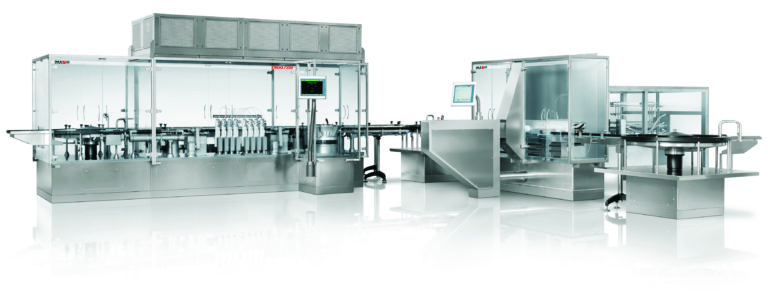
A key focus of the pharmaceutical market today is to achieve even greater flexibility during production. Xtrema is the answer that IMA Life gives to the world of aseptic filling. Its design features a great flexibility offered thanks to the integration of modular equipment, providing the adaptability and customization that pharmaceutical companies need when developing new production concepts

Monica Cervellati

State-of-the-art constructive details coupled with consolidated and worldwide re-known filling technology, make the New Xtrema Series the latest technological breakthrough in aseptic filling. Designed with a modern modular concept, Xtrema gives the possibility to actively manage the production process, by tailoring the different machine phases to the actual production needs. Xtrema F2000 is an in-line filling & stoppering machine with continuous motion positive in-line transport system.

Implement process reliability

What does it mean to make a quality and reliable product? And when we are talking about sterilization, how do we measure a process that cannot be visually verified? The partnership between Mocom and PTM Consulting have made possible to achieve all of these primary objectives

Lorena Origo

PTM Consulting has decade-long expertise as a consulting firm focused on supporting companies that invest in product and process innovation to improve quality and regulatory compliance as well as reducing time and costs. Since 2012 the company has been engaged in a partnership with Mocom, a key player company for over twenty years in the production of sterilizers, heat sealers, accessories and hand pieces for dental applications, The meeting with Annita Piermarini, CEO Mocom, and Paolo Mazzoni, owner of PTM Consulting is an opportunity to deepen the strategy developed to revitalize the brand by focusing primarily on the quality of the product.

Strategies against counterfeit drugs

The diffusion of counterfeit medicinal products is a growing problem at worldwide level. Governs, international and national authorities, and industries are working to make impossible that counterfeit drug can harm people

Altea Pierluigi

Christian Gross, Head of packaging design and artwork service, Aesica

Pharma World Magazine has discuss the counterfeit drugs issue with Christian Gross, Head of packaging design and artwork service, Aesica.

Which are the official worldwide data on counterfeiting in pharmaceutical sector?

The EU commission expects that 7-10% of medical products on the worldwide market are fake and this is set to increase over the course of the next few years. Approx $660 billion revenue loss worldwide last year. Asia and Africa are the no 1 markets for fake products, India accounted for 31% of all fake products, United Arab Emirates 31% and China 20%. Nevertheless in the last year more and more fake products entered the EU market. 80% of the fake products are discovered at the border. The German customs have experienced an increase of 400% in the year 2008. The most prominent types of counterfeiting comprised the following: less or no active ingredients, wrong ingredients and faked packaging.

Adverse drug reactions: the EU-ADR Alliance project

The EU-ADR Alliance is an EMA (European Medicines Agency) project that follows the 2008-2012 EU-ADR project. EU-ADR has developed a computer system exploiting data from electronic healthcare records (EHR) for the early detection of adverse drug reactions. Italy will be one of the five nations enrolled in this project

Caterina Lucchini

Following the 30 million of data analyzed in 2008-2012 by the EU-ADR project on drug adverse reactions, a new project, the EU-ADR Alliance, will start. Italy, Germany, United Kingdom, Denmark and The Netherlands will be enrolled in this project, allowing the consultation of more that 45 million records from clinical databases on three principal topics: use of oral contraceptives, risk of cardiac valve disorders associated with the use of biphosphonates, and monitoring of the effectiveness of risk minimization in patients treated with pioglitazone-containing products.

Young Turks have a dream

Its Gross domestic product (Gdp) has been rocketing by a 5,2% average on an annual basis throughout the 2002-2011 decade. That allowed Turkey to outpace leading emerging countries such as Brazil, Russia, Poland or Korea. And pharmaceutical industry is one of the pillars of its growth

Roberto Carminati

Recent figures released by the Turkish national institute of statistics pointed out that in its effort to become number 28 member of the European union the nation has been significantly strengthening its economy throughout the last decade. The result is an admirable growth that brought Ankara to a leading position among the so called emerging countries all over the planet. Its Gross domestic product or Gdp outpaced last year that of nations such as Brazil, for instance, South Korea or Russia. Back in 2002 local Gdp was 231 billion Us dollars worth; while at the end of 2011 it reached the record peak of 772 billion dollars. That translates into a 10.444 dollars pro capita Gdp, nearly three times more than the value archived at the beginning of the century (3.500 Us dollars).

Botulinum toxins, from wrinkles to bladder

0

Researchers have been in fact often able to turn in our favor proteins from which it is better to stay away. It is the case of botulinum toxin which, just to name the most famous use, “rejuvenate” every year the appearance of an always increasing number of people. In addition to the famous Botox, Clostridium botulinum toxins have been studied and applied with success for the treatment of numerous pathologies. The last in order of time is the overactive bladder. A disorder that causes sudden ran to the bathroom to thirty million people in the U.S. alone

Eros Fabrizi

Recently the U.S. Food and Drug Administration expanded the approved use of Botox® (onabotulinumtoxinA) to treat adults with overactive bladder who cannot use or do not adequately respond to a class of medications known as anticholinergics. Overactive bladder is a condition in which the bladder squeezes too often or squeezes without warning.

The best pharmaceutical performance

The 2012 has gone and we are staring to face the 2013, the big glaciation year. How was the last year and what the pharmaceutical experts and the leaders foreseen for the next future are the subjects of this article

Caterina Lazzarini

During 2012 there was the consolidation of the trends, already under way in the last decade: the importance of the emerging markets incremented whilst the mature ones suffered under the patent cliff and the price cuts. As a consequence the pharmaceutical companies have started to rethink themselves changing business models and organizations.

Newsstand

  • Supplement to n.5 - October 2025 NCF International n.2 - 2025
  • NCF International n.1 - 2025
  • Supplemento to n.9 - October 2024 NCF International n.3 - 2024