Home Authors Posts by Manuele Cantù

Manuele Cantù

7 POSTS 0 COMMENTS

Ten years of collaboration for EMA and the WHO

The formal collaboration between the European Medicines Agency (EMA) and the World Health Organisation (WHO) has reached its 10th anniversary in September 2025. It has been a long journey, during which the two organisations have shared their commitment to addressing global health challenges. The partnership began with the signing of a confidentiality agreement in September 2015, after which the focus shifted to cooperation in scientific evaluation, capacity building, and enhancing regulatory efficiency in order to contribute to public health worldwide.

One of the main joint initiatives is the EMA’s EU Medicines for all (EU-M4all) programme, which supports the development of global regulatory capacity and contributes to the protection and promotion of public health beyond the EU. Other key areas of high-impact cooperation include existing and emerging threats to public and animal health, and ensuring more rapid access to essential medicines through various mechanisms. Good reliance practices aim to promote the effective use of global regulatory resources. Other examples of collaboration include cooperation on pharmacovigilance and inspections, and strategic partnerships to ensure the quality and safety of medicines, including EMA’s WHO Listed Authority (WLA) designation.

The composition of the EMA’s Emergency Task Force for preparedness

0

The updated composition of the Emergency Task Force (ETF) was published by the European Medicines Agency on 17 July 2025. Established under regulation (EU) 2022/123, the ETF is responsible for managing preparedness for public health emergencies. The new composition of the ETF reflects the expertise required to prepare for potential future public health emergencies of biological origin based on past experience. Additional ad hoc experts may be appointed as required in relation to other potential threats of chemical, nuclear or radiation origin.

The ETF is co-chaired by Marco Cavalieri, a staff member of the EMA appointed by the Agency’s Executive Director, and Bruno Sepodes, the Chair of the Committee for Human Medicinal Products (CHMP). The Task Force also includes the Chairs of the Pharmacovigilance Risk Assessment Committee (PRAC) and of the Paediatric Committee (PDCO), as well as representatives from several of the EMA’s committees and Working Parties. The ETF is completed by three EMA staff members, one representative each from the Coordination Group for Mutual Recognition and Decentralised Procedures – Human (CMDh) and the Clinical Trials Coordination and Advisory Group (CTAG), and two clinical trial experts proposed by the Clinical Trials Coordination Group (CTCG).

The new EU Commissioners Health, Innovation and Industrial Strategy

Members of the new EU Commission were announced on 17 September 2024. Hungarian Olivér Várhelyi is the new Commissioner for Health and Animal Welfare. He served as European Commissioner for Neighbourhood and Enlargement in the first von der Leyen Commission, and he previously covered various roles in the EU institutions. According to the Mission Letter, the mandate should focus on completing the EU Health Union. Among key priorities are the diversification of supply chains, strategic inventories and competitiveness. The finalisation of the review of the pharmaceutical legislation and the proposal of a Critical Medicines Act and a new European Biotech Act are among the announced lines of action. 

Bulgarian Ekaterina Zaharieva is the new Commissioner for Startups, Research and Innovation. She is member of the Bulgarian Parliament, and served as Minister of Justice (2015-2017), and as Deputy Prime Minister for Judicial Reform and Minister of Foreign Affairs (2017-2021). Among the main goals highlighted in the Mission Letter are the expansion of the European Innovation Council and the European Research Council, and the proposal of a European Research Area Act to support the free movement of researchers, scientific knowledge and technology. A European Innovation Act should support the simplification of the regulatory framework and access to venture capitals. Commissioner Zaharieva should also collaborate, among others, to the preparation of the new multi-disciplinary Strategy for European Life Sciences.

The French Stéphane Séjourné is the new Executive Vice-President for Prosperity and Industrial Strategy. He served as Political adviser to the French President (2017-2019), and as Minister for Europe and Foreign Affairs (2024). His portfolio includes also Industry, SME and Single Market. Among main goals is the setting up of a Competitiveness Coordination Tool and the development of the Clean Industrial Deal (in collaboration with the Commissioner for Climate, Net Zero and Clean Growth, the Dutch Wopke Hoekstra). Among expected actions are the proposals of a Industrial Decarbonisation Accelerator Act and the implementation of the Net Zero Industry Act, as well as the development of the future European Competitiveness Fund and the revision of the Public Procurement Directives. An EU Critical Raw Material Platform to support joint purchasing and management of strategic stockpiles is also planned.

MedTech Europe’s Manifesto for the new EU political cycle 2024-29

In preparation to the next 2024-29 EU political cycle, MedTech Europe has published its manifesto detailing possible actionable policies based on the achievements of the closing mandate. According to the industrial association of the medtech industry, health systems must become more patient-centric, digitally advanced, resilient and sustainable. Medical technologies may support this transformation, provided they reach patients and healthcare systems. As for patient-centric healthcare, key challenges should be tackled by making the current CE marking system for medical technologies more efficient and predictable. Harmonised applications are deemed useful to make Europe more attractive for investments and R&D.

A true single market for digital health and health data, aligning EU countries in their approach for the identification, authentication, security and interoperability of digital medical technologies, would also be needed to support the European leadership in developing the best environment for AI-enabled medical technologies. Resilience of healthcare systems would require improved crisis preparedness and response through well-coordinated mechanisms for joint procurement of medical countermeasures, together with a regulatory framework able to embrace the full potential of real-world evidence. Sustainability of healthcare systems should be based on a future legislation consistent with sector-specific regulatory requirements.

Joint statement on the revision of the Product Liability Directive

Twelve European industrial associations, including EFPIA, MedTech Europe and COCIR in the healthcare sector, have published a joint statement to call for a major rethink of the ongoing revision of the Product Liability Directive (PLD). The main concern expressed in the document is the lack of balance in the proposed revision, that according to the associations could undermine European competitiveness and significantly raise litigation risk, legal complexity and uncertainty for European businesses. This might negatively impact on both investment in innovation and consumers. The industrial associations suggest to maintain the current framework, that led to good results  for both parties since its entry into force in 1985. Critical parts of the proposed PLD revision, wrote the associations, refer to the expanded scope to include digital products, the de facto reversal of the burden of proof, disproportionate disclosure of evidence provisions and removal of compensation thresholds.

Requests to the Trilogue, now in charged of final negotiations, include limits to the alleviation of the burden of proof, which should be significantly narrowed, and clarified as for what claimants must do and prove before any liability can be presumed. More safeguards would be needed as for the disclosure of evidence, in order to protect businesses against abusive discovery exercises or disclosure of commercially sensitive data or trade secrets. According to the associations, disclosure of evidence should be limited to only what is strictly necessary and proportionate. A greater attention should be also posed in the inclusion of software in a strict liability regime, and how to apply the concept of defectiveness. The associations agree with the EU Parliament proposal of a threshold to prevent frivolous claims.

Source: EFPIA

ICH, three new topics for harmonisation

0

The Assembly adopted three new topics for harmonisation at the Vancouver meeting, with the starting timeframe to be determined in a subsequent step:

  • “General Considerations for Patient Preference Studies” – a new ICH Efficacy Guideline which will provide considerations for a systematic approach to designing, conducting, analyzing and presenting Patient Preference Studies
  • “Nonclinical Safety Studies for Oligonucleotide-based Therapeutics” – new ICH Safety Guideline which will clarify regulatory expectations on nonclinical safety evaluation of various Oligonucleotide-based treatment options
  • “Bioequivalence for Modified-Release Products” – a new ICH Multidisciplinary Guideline which represents an important next step for harmonisation of bioequivalence standards for more complex dosage forms

The International Generic and Biosimilar Medicines Association (IGBA) commends the General Assembly of the International Council for Harmonisation of Technical Requirements for Pharmaceuticals for Human Use (ICH) for its adoption of a new topic focused on the harmonisation of “Bioequivalence for Modified- Release Products.” This significant development, which took place at the recent ICH meeting in Vancouver, Canada, marks the introduction of a new ICH Multidisciplinary Guideline, which aims to further strengthen consensus and harmonisation among ICH members regarding bioequivalence standards for more complex dosage forms. These efforts build upon the existing harmonisation initiatives found within the upcoming M13 series of bioequivalence guidelines.

Source:
https://admin.ich.org/sites/default/files/inline-files/ICH46_Vancouver_Meeting_PressRelease_2023_0620_2.pdf
https://www.igbamedicines.org/doc/20230626_ICH_PR_New_ICH_BEQ_topic.pdf

HAZEL® GATEWAY GW-MB1: simplify the validation of recovery times in airlocks

The new Annex 1 adopts the Quality Risk Management method to guarantee prevention from the microbic, particulate and biological contamination. This model calls for the adoption of a Contamination Control Strategy, which takes into consideration from a systemic perspective all the critical components of the production cycle. In particular, Section 4.16 mentions the concepts of Design Control Strategy linked to the control of overpressures according to justified and validated strategies.

The theme of recovery times

In this regard, the possibility of managing and validating the “recovery times” of the airlocks and pass through boxes is particularly relevant. The setting and validation of recovery times very often takes place in the course of the Cleanrooms validation phases, setting the appropriate values on the control units or PLCs that control the airlocks or pass through boxes. Once the recovery times have been validated, they often remain set to the initial values even if the environmental conditions vary; a possible update of the recovery times, in fact, requires a in-field burdensome activity (possible in some cases only during downtime periods) and a new validation.

Dos&Donts’ solution

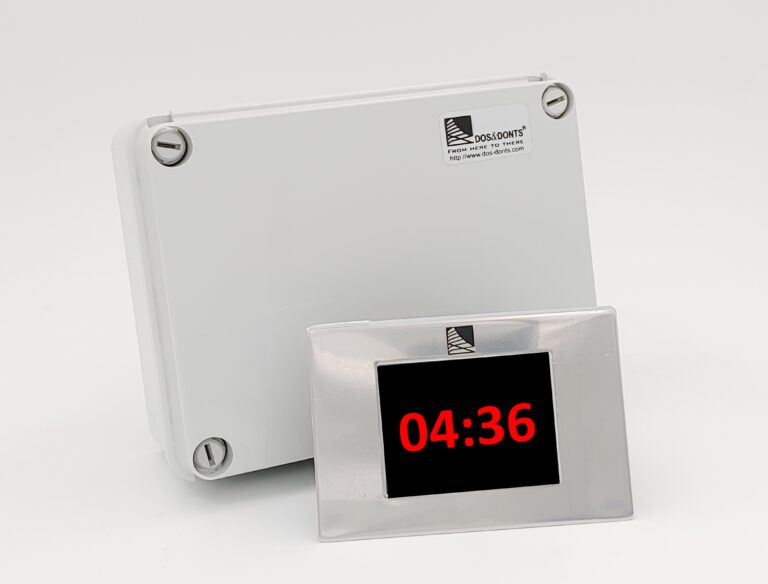
Dos&Donts has decades of experience in the design and production of control systems for airlocks; as a part of its articulate Pharma 4.0 development programme, it proposes a solution to make simple and immediately validable the update of recovery times, without intervention of specialised personnel and without need to stop the production cycles. The system consists of a Gateway and decremental counters with display, which can be positioned at the airlock or material pass through.

Use of gateway with Dos&Donts’ control units

Recovery times are set directly on the BMS, that transfer them through the Gateway to the Airlock control units.
Dos&Donts’ ILOCK Modular control units update the timer associated with the airlock and visualize the set time on the display. When the condition is met to start the recovery time, namely after opening and re-closing of the external door, the timer starts to decrement while showing the residual time on the display; after the set time has expired, the airlock is back again operational. At all times, the BMS can check the actual compliance to the set recovery time.

Use of the gateaway with different controllers

The Gateway and the count-down timers can also be advantageously used on existing plants and with any PLC model. The only requirement is that the PLC governing the airlock has a digital output to notify the opening and closing of a door, and a digital input to allow for the activation and deactivation of the recovery time. Recovery times are set on the BMS and transmitted to the count-down timers. When the PLC notifies its count-down timer to activate the recovery time, the timer starts and decrements. When the set time runs out, it notifies the PLC the time has expired, thus allowing to return to normal operating conditions.

The advantages of this solution are:

  • Recovery times can be modified at all times by in-house staff without need of specialists, both during validation and periodic verification.
  • The recovery times data are automatically validated at the BMS level, allowing for the easy conduct of the Audit Trail and a sharp reduction of the time required.
  • Count-down timers allow operators to visualize the passing of time during waiting phases.

Dos&Donts’ solution for the management of recovery times for airlocks and pass thru

Each individual unit of a 4.0 architecture can be IP addressed, and it can exchange information with the other units in order to effectively operate complex functions.

Newsstand

  • Supplement to n.5 - October 2025 NCF International n.2 - 2025
  • NCF International n.1 - 2025
  • Supplemento to n.9 - October 2024 NCF International n.3 - 2024